They can track your accounts.
They can’t run your household.
Where we win, where we lose, and which job each tool is for.
For a decade my family ran on two systems: an aggregator for the plumbing, a 76-sheet workbook for the planning, analysis, and insights.
Every tool below is good at its job, and a couple are the best in the world at it. But none of them could retire my workbook. The plan, the variance, the “why is this month off?” all still lived in the spreadsheet.
That’s the itch Ledger of Life exists to scratch: the plumbing, the planning, the analysis, and the insights in one book.
So here’s the honest map. Ledger replaces Empower plus the workbook. It was never trying to replace Mint. Where another tool does its job better than we do, the table says so. You’d find out anyway — I’d rather you hear it from me.
Which tool are you coming from?
| Ledger of Life | Empower | Monarch | Copilot | YNAB | Kubera | ProjectionLab | |
|---|---|---|---|---|---|---|---|
| Automatic account sync | Yes — via Plaid | Yes | Yes | Yes | Yes | Yes | No direct account linking — manual and plugin sync |
| P&L with plan vs. actual vs. prior yeardollar and percent variance, month and YTD | Yes | No — a single spend target, month over month | Planned/actual/remaining per category; no prior-year or YTD variance columns | No — spend tracking | Envelope plan; not a P&L | No budgeting or P&L | Projections, not actuals |
| Multi-entity householdspouse, trusts, LLCs — income and net worth by entity | Yes | Account tags only; no per-entity rollup | Shared household with roles; no entity-level rollup | Partner sharing via one shared login; no roles or per-person views | No | Black tier ($2,500/yr): ownership tags and nested portfolios | No entity ledger |
| Private markets with return mathcapital calls, distributions, return of capital, DPI | Yes | Manual static holdings only | Manual holdings; no capital-call or DPI metrics | No | No | Committed capital, call/distribution schedule, IRR — no DPI or TVPI | As plan assumptions only |
| True cost basis net of incomebasis minus every dividend and option premium, per holding | Yes | No | No | No — average cost and total return only | No | No — IRR/ROI, not basis reduction | No |
| Bring your whole historybeyond Plaid’s up-to-24-month, institution-dependent window | Yes — Empower, Monarch, Quicken, and CSV importers | No outside import; CSV export only | Mint import at the 2024 shutdown; otherwise the sync window | Mint transactions via CSV; no investment-history backfill | Fresh start by design | AI Import updates balances; no competitor migration | N/A — plans, not history |
| Tax history & lifetime effective rateyour filed years | Yes | No filed-return history | No filed-year history (Plus: a gains/losses tax tool) | No | No | No — a flat-rate liquidation estimate only | Rich future-tax modeling in plans; no filed-year history |
| Data architecture | One encrypted database per household | Shared cloud | Shared cloud | Shared cloud | Shared cloud | Shared cloud | Google Cloud; no local-only mode |
| Who pays | You. Customer-funded — never data-funded, no advisory upsell | Nobody — the free dashboard is the front door to a wealth-management business | You (subscription) | You (subscription) | You (subscription) | You (subscription) | You (subscription) |
| Envelope / zero-based budgeting | No — plan vs. actual, not envelopes | No | Category budgets | Spend categories | Yes — the category king | No | No |
| Mobile app | Built for the phone — installs to your home screen, no App Store | Yes | Yes | Yes (iPhone, iPad, Mac, and web; no native Android) | Yes | No native app — PWA only | No — web app only |
| Time in market | In beta (2026), built and run by one founder | Years; established company | Years; established team | Years; established team | Two decades | Years; established | Years; solo founder |
Scroll sideways for all seven columns →
Mint did all of this for free, funded by ads and your data — and Intuit shut it down in 2024. Free tools die when the real customer loses interest. That’s the argument for customer-funded software, in one sentence.
Claims are cheap. Screenshots aren’t.
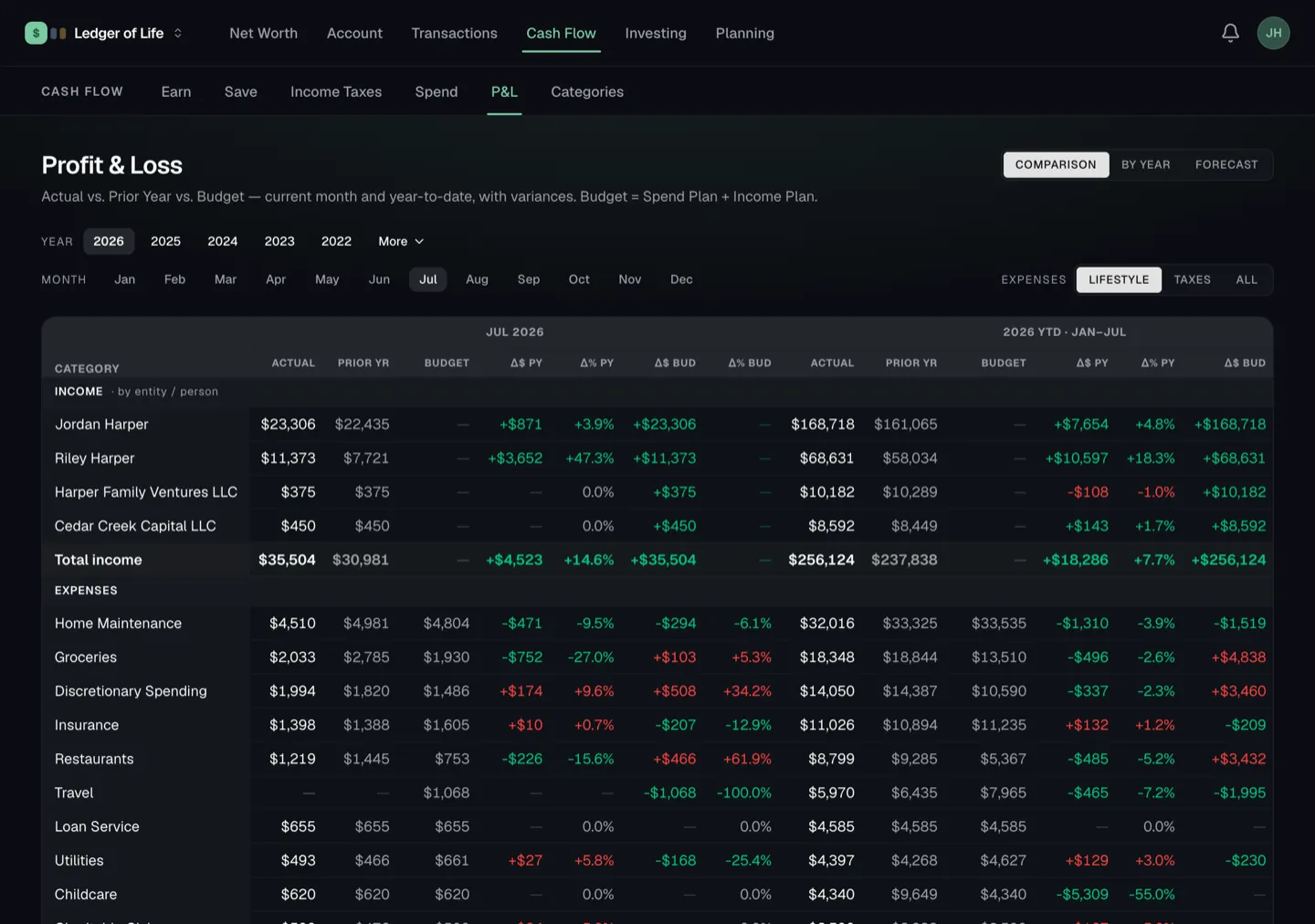
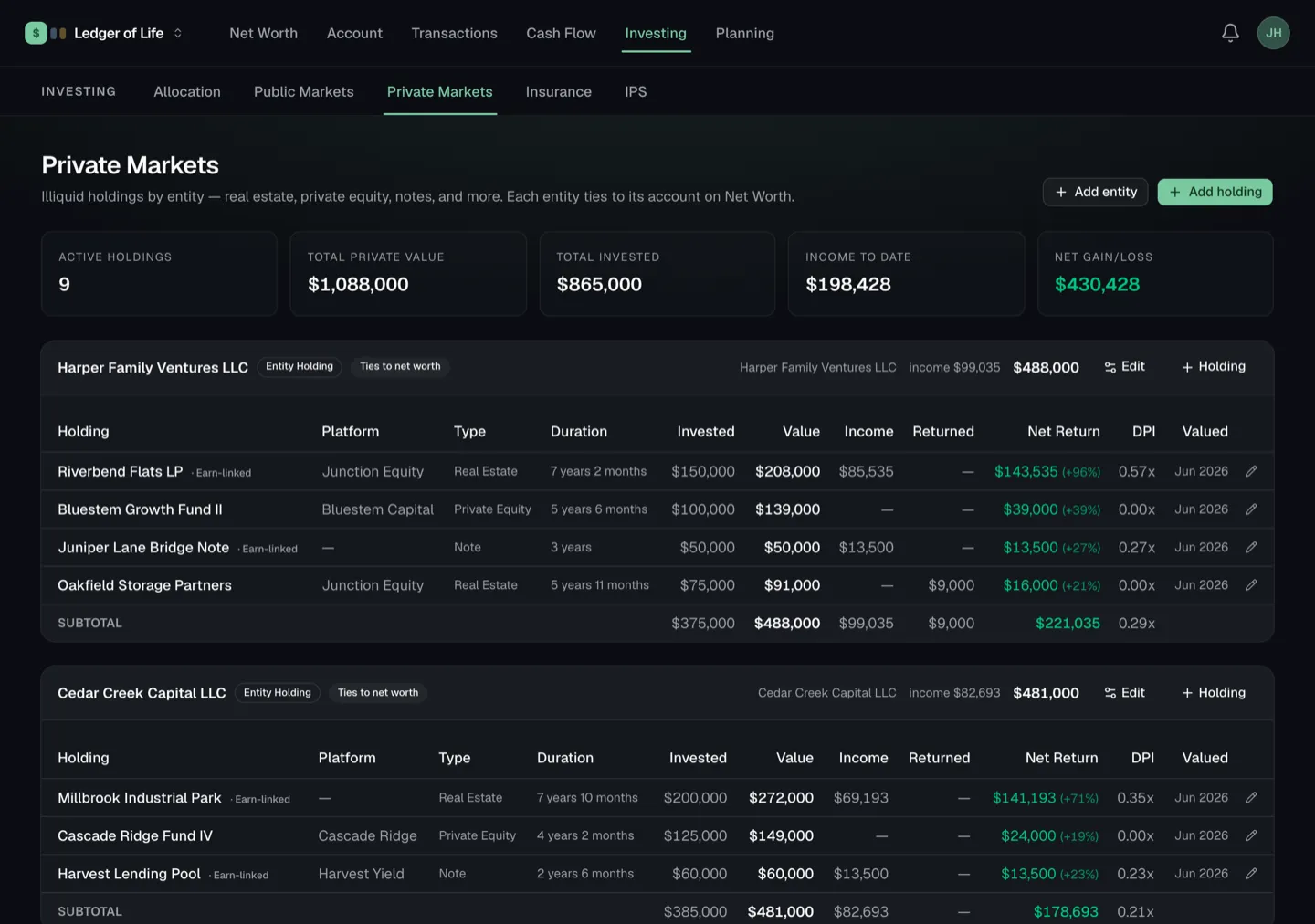
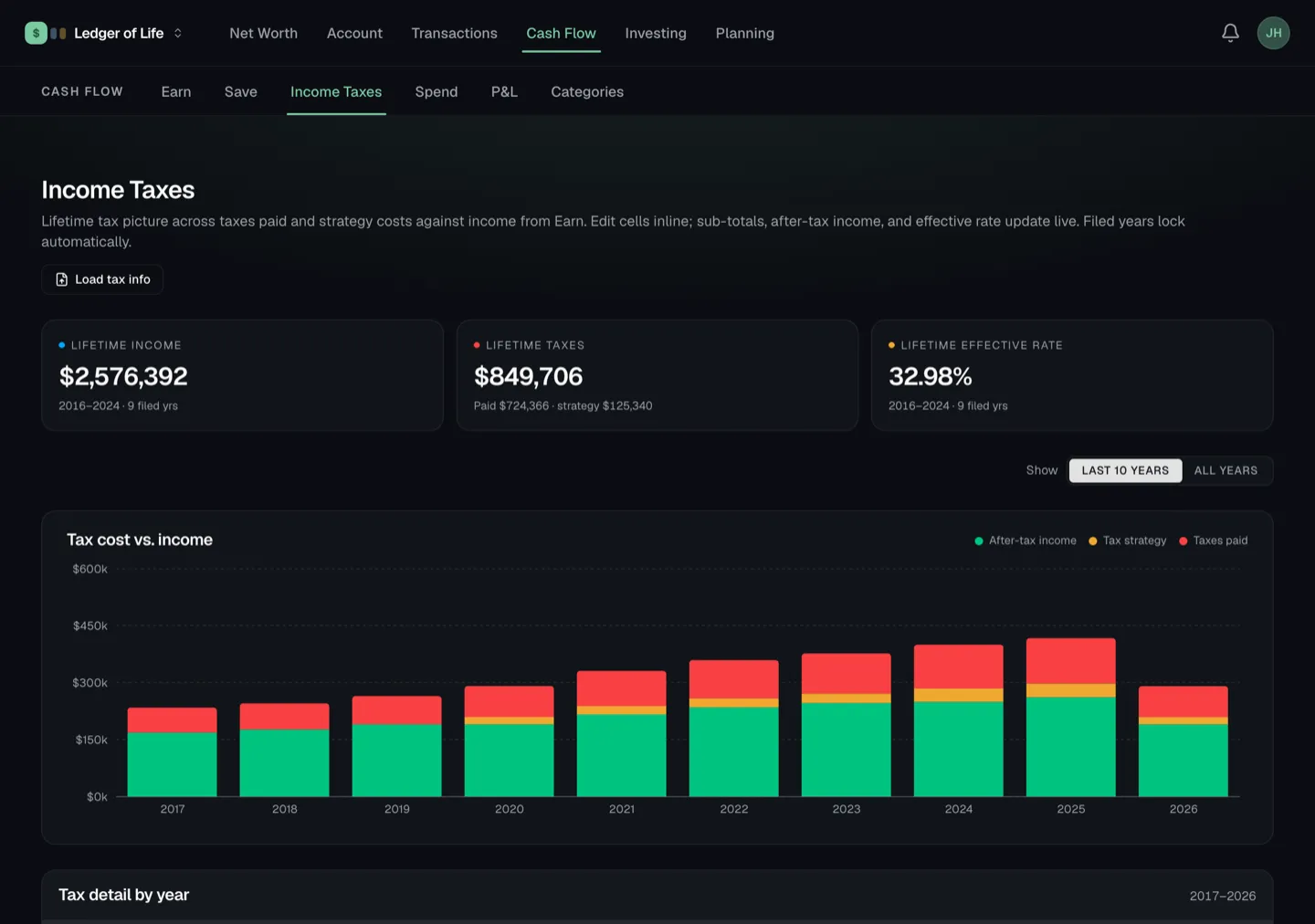
Read the losses first.
We’re the newest tool on this page, a 2026 beta while everything else has years on us. And if envelope budgeting changed your life, YNAB is the better tool for that job. Keep it.
Now the row that matters: who pays. Fair is fair: Empower’s is the best free net-worth dashboard ever built, and it really is free. No assets required, no trial clock. You can run it for years and never pay a dime. Their wealth-management arm charges 0.89% a year if you ever want their advice, but nobody makes you take that meeting.
The real price of free is staleness. When you’re not the paying customer, the product stops moving. The dashboard has had a decade-plus, from the Personal Capital days to Empower, and some of my beta users showed up still carrying complaints about it they’d had for years. During this beta, I fixed those things in Ledger myself. Empower still hasn’t. Ledger is customer-funded, and that’s the whole difference: when you pay for the product, the product has to keep earning you.
I used Empower for eleven years, and I recommended it for most of them. I left when I finally understood what free was costing me, and I built the thing I actually wanted: a real balance sheet, a real P&L with plan vs. actual, and a real plan, in one encrypted book you own. And your whole history comes with you (Empower, Monarch, Quicken, or any CSV), not just the last 24 months.
The same tools, one line each
- Empower
- The best free net-worth dashboard ever built — built to find clients for a wealth-management business. Great plumbing; you’re the lead.
- Monarch
- The rightful heir to Mint, and the best mainstream household money app going. It runs the everyday household beautifully — and thins out when the trusts, K-1s, and private deals show up.
- Copilot
- The most beautiful spend tracker on the iPhone (and, lately, the web). A different job: it tells you where the money went, not how the household performed against plan.
- YNAB
- A behavior-change method, not a balance sheet — its net worth is a trend line, not a book. If the spending habit is the problem, start there. Ledger assumes that job is already done.
- Kubera
- The premium net-worth tracker for complex balance sheets, and it’s genuinely good at it — committed capital, capital-call schedules, IRR. It’s the balance-sheet half of the job: no P&L, no budgeting, no tax planning.
- ProjectionLab
- The best DIY what-if machine in personal finance — a flight simulator for your retirement. Ledger is the flight recorder: actual history, actual variance, the real book.
- Mint
- Retired 2024. Free, ad-funded, and gone. When you’re not the customer, the product can leave you — which is why Ledger is customer-funded, period.
- Excel / the workbook
- Undefeated on depth. Undefeated on Sundays consumed. Ledger is for people who love what the workbook does and are done maintaining it by hand.
Whichever tool you’re leaving, your history comes with you.
Empower, Monarch, Quicken, or any CSV — your whole net-worth story, back to its first chapter. That’s the part no one else can offer, because it’s the door out of their product.
Join the waitlistInvite-only. The beta is full — 50 households. The waitlist is for the official launch.