Money. Health. Time.
One ledger.
You get one life — and everything in it is a balance. Ledger of Life keeps all three — your net worth to the dollar, your sleep to the night, your life to the second — in one encrypted book that belongs to your household alone.
Invite-only. The beta is full — 50 households. The waitlist is for the official launch.
Households in the US and Canada for now — that’s where our bank and brokerage connections reach.
The rigor of corporate finance, sized for a household.
Consumer money apps promise simplicity. Ledger of Life promises rigor — the discipline of corporate financial planning, pointed at your own life. Net worth across every account. A real cash-flow P&L with budget vs. actual vs. forecast. Taxes measured from gross pay, not what's left. Public and private markets, side by side.
Every account, one book
Banks, brokerages, retirement, real estate, private holdings, insurance — one net-worth line you can trust, with history back as far as your records go.
A P&L for your life
Budget vs. actual vs. forecast with drill-down to the transaction. Variance you can act on — not a pie chart of where the money already went.
Gross pay, captured
Effective and lifetime tax rates from your real gross income — the number most apps never see — plus a planning grid for the strategies that lower it. It's not how much you make; it's how much you keep.
Public and private markets
Brokerage positions with options and treasuries handled properly, next to your private deals — entities, capital calls, distributions, real net return.
Keep the sheet. Lose the manual work.
Built by a spreadsheet person, for spreadsheet people. Import your workbook history, export anything you see — the app respects the sheet instead of replacing it.
The ledger your money exists for.
Wealth is a means. Ledger of Life gives your health the same book-keeping your money gets: import years of Apple Health history, watch your sleep against your own 90-day baseline, and see the one line every other ledger depends on. Your health ledger is yours alone — a separate encrypted book per person, invisible even to your household.
Sleep takes roughly a third of your time — the tax you pay for being human. It's also the biggest lever in the longevity equation. The ledger makes both visible.
The best longevity drugs are free — five levers, one ledger:
You were born a time billionaire.
An eighty-year life is about 2.5 billion seconds — a fortune everyone receives and no one keeps. You can't save it, you can't earn more of it; you can only decide how it's spent. The Time ledger is where you watch the balance, and where you keep what the spending bought: your memories, moments, and milestones.
No mockups. This is the software.
Everything above, running on a real book — one with a decade of history, two earners, private deals held through entities, and a tax picture going back to 2016. The numbers are invented. The software is not.
Captured from the live application on a demonstration household. The figures are illustrative — the photographs on the timeline are the founder’s own. No customer data appears anywhere on this page.
Net worth, back as far as your records go
Ten years of month-end closes in a single line, filterable by account class. The tiles underneath are the ones that actually say something: today’s live value against the last close, change year to date, lifetime annualized growth, and how much of everything ever earned is still on the balance sheet.

Where the money actually is — and where it drifted
Net worth split by category, beside a decade of how that split has moved. The stacked view is the one that earns its place: you can watch a concentration build year by year and decide whether you meant it.

A real P&L, for a household
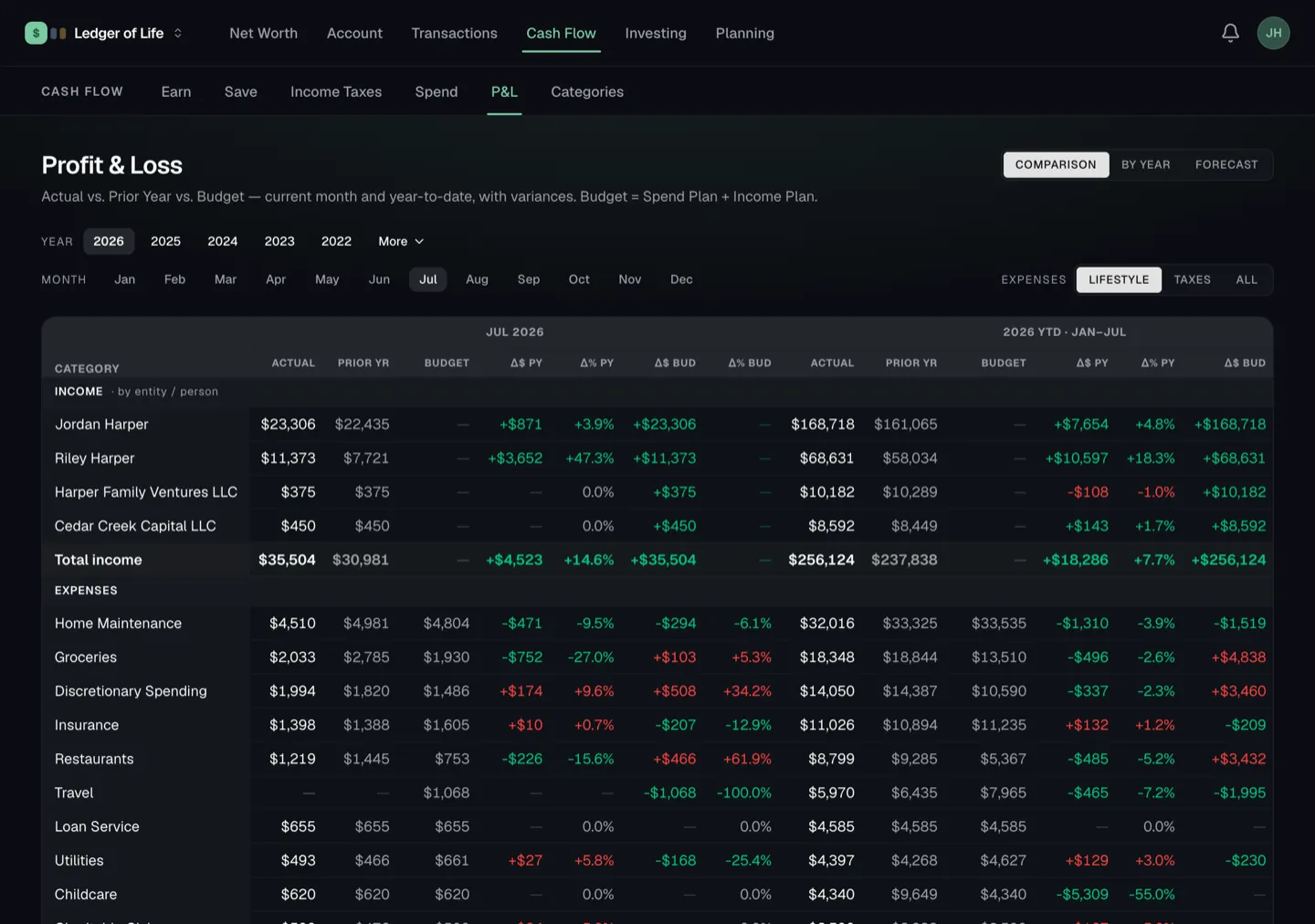
Actual vs. prior year vs. budget — for the month and year to date, with variance in both dollars and percent, and income broken out by entity and person. This is the corporate FP&A pack, pointed at a family instead of a business unit.
Taxes measured from gross, not from what’s left
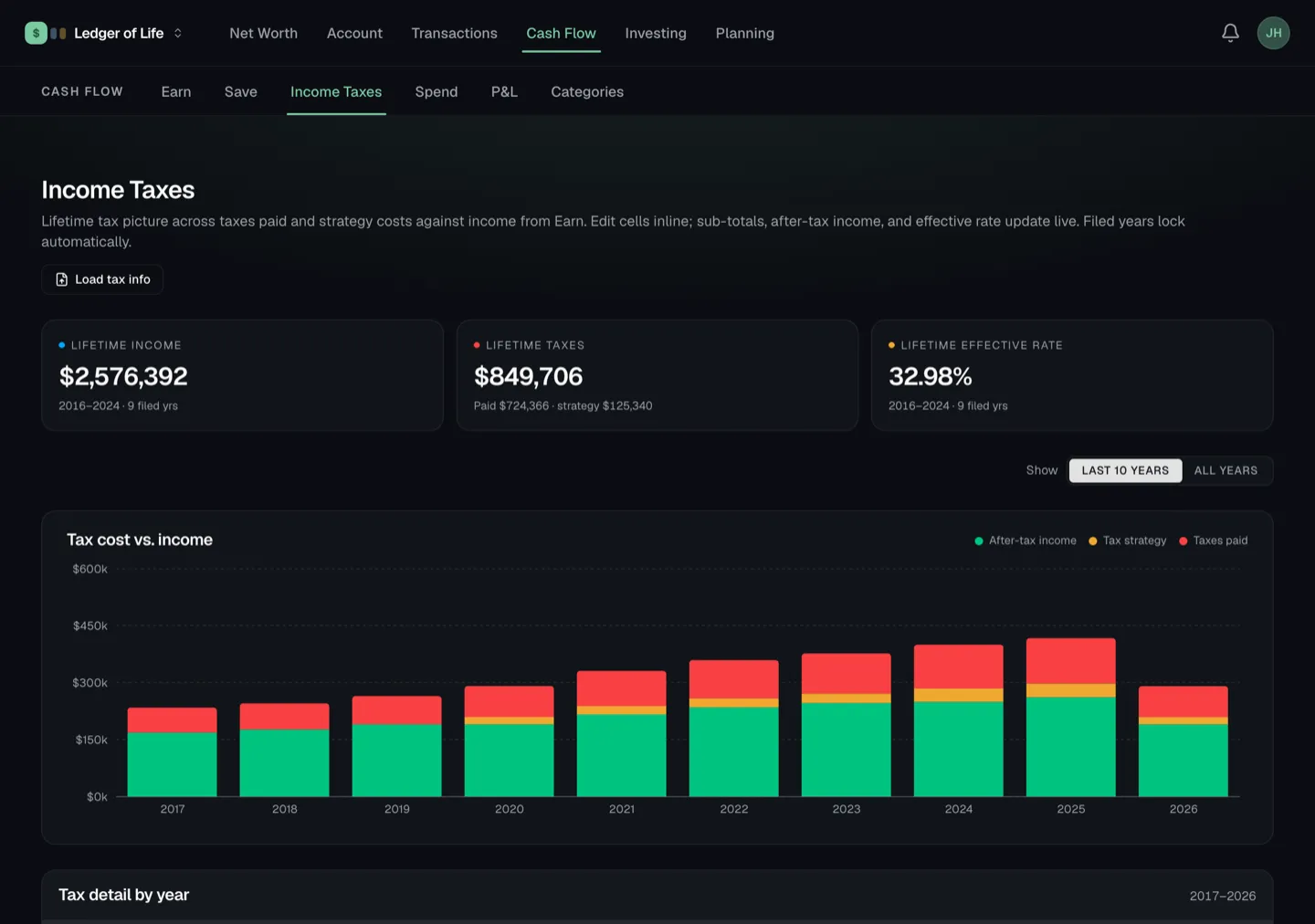
Lifetime income against lifetime tax — with what was paid and what the strategies cost kept separate — and an effective rate you can watch move year over year. Most money apps never see your gross pay, so they cannot compute this at all.
Spending with a plan behind it
Rolling twelve-month spend against the prior twelve, trends by category, and recurring charges surfaced with their cadence and average cost — so the subscription you forgot about has a line, not a shrug.

Every position, and what it really cost you
Holdings by account with quantity, price, cost per share, market value and gain. Plus the line almost nothing else shows: dividends collected and option premium harvested, netted down into a true cost per share.

Your cost basis is not the number your broker reports
Open a holding and the gross basis walks down to a net one — dividends, call premium, put premium and open premium at risk each subtracted in turn. Every option position, open and closed, and every dividend it ever paid, on one screen.

Private markets, treated as seriously as public ones
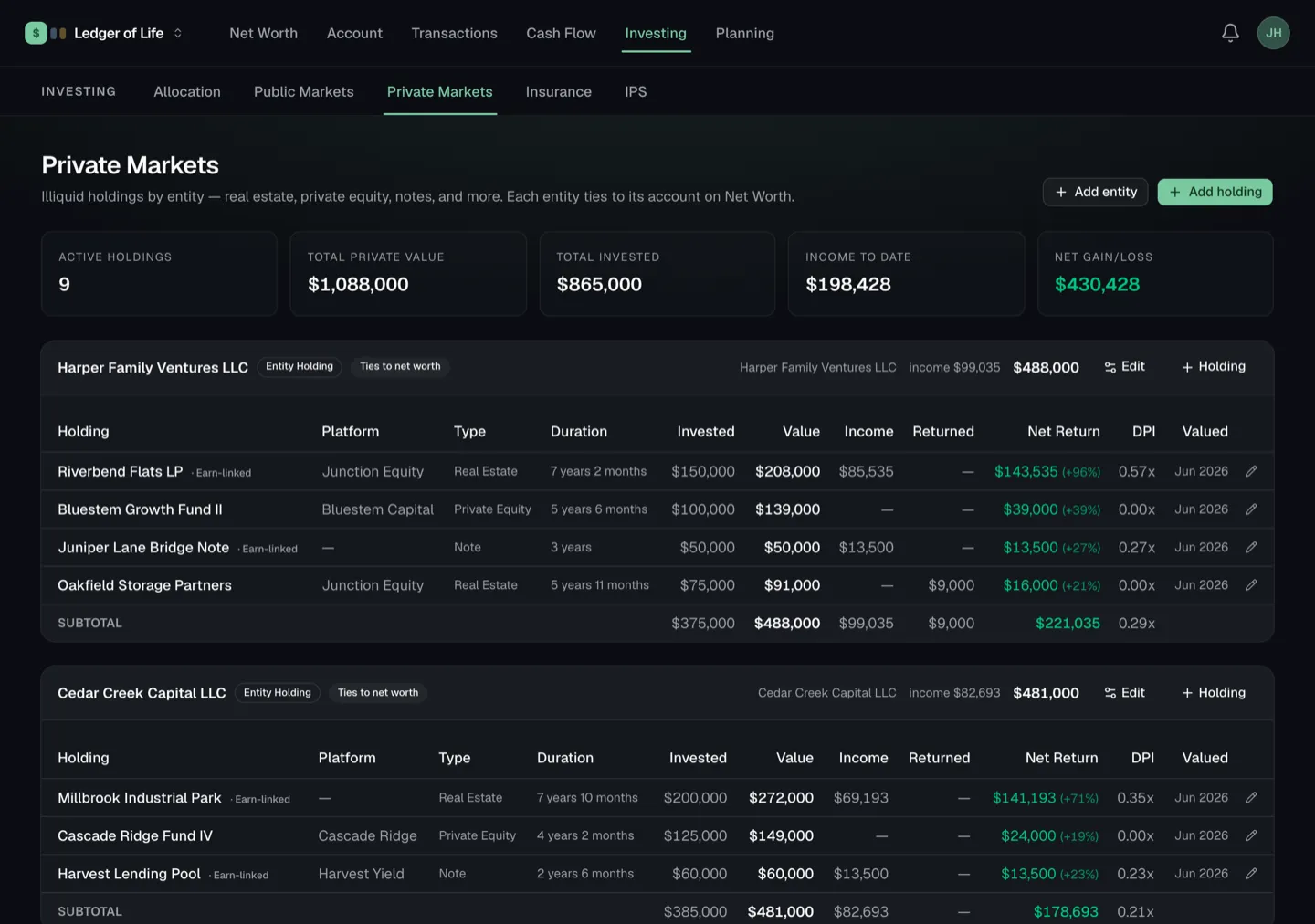
Real estate, private equity and notes, grouped by the entity that holds them and tied back to their account on net worth. Invested, current value, income to date, net return and DPI. This is the part consumer apps leave out, and for a lot of households it is where the money actually is.
Open a deal and it carries its whole history
Capital invested against cumulative income and monthly cash flow, the entity that holds it, the income source it feeds back into, and the arithmetic that matters — distributions, capital returned, DPI, and the valuations that drive net worth.

One box for every month of a life
The memento mori chart: months lived, months remaining, and how much of your horizon is already spent. Money is the renewable currency. This is the one you can only spend down.

The months you’ll actually remember
Every box on that chart can hold what actually happened in it — photographs and a note, not just a label. A birth, a first dog, the year the number finally moved, a week on the water. The trip pays once. The memory pays every time you open the box.

Sleep, steps, recovery, body
Apple Health in, dashboards out. No coaching, no streaks, no badges — a ledger. It is also what prices the sleep tax on the Time page: real nights, not an assumption.

They can track your accounts. They can’t run your household.
Six rows against the tools you’re probably sitting in. Losses included — you’d find out anyway.
| Ledger of Life | Empower | Monarch | Kubera | |
|---|---|---|---|---|
| P&L with plan vs. actual vs. prior year | Yes | No | No variance columns | No P&L |
| Trusts & LLCs, income and net worth by entity | Yes | No | No | $2,500/yr tier |
| Private markets: capital calls, DPI | Yes | No | No | IRR, no DPI |
| Bring your whole history with you | Empower, Monarch, Quicken, CSV | No import | Sync window only | Balances only |
| Who pays | You — never data-funded | You’re the lead | You | You |
| Mobile app | Not yet — web | Yes | Yes | No native app |
See the full comparison — all seven tools, twelve rows, losses first → Every claim verified against current sources. If a row is wrong, tell Dom.
A life worth living is a life worth measuring.
Why I spent a decade running my family on a 76-sheet workbook — and then built the tool I couldn’t buy.
You get one life. One ledger. Three accounts fund it: Money. Health. Time.
For ten years I ran my family on a 76-sheet workbook — apps for plumbing, Excel for thinking. The apps never learned the things that actually move the needle: the tax planning, the savings rate treated like the lever it is, the true cost of every position. So when I finished selling my company, I built the tool I couldn’t buy at any price.
Then I went past money. Sleep and strength on the same page as net worth. And 1,200 marbles — one for every month of a hundred years — because you can always make more money. You can’t make more time.
The waitlist below is where launch invitations will come from.
The rest of the story — the welfare kid, the crackpot goal, the loan I took out against my own health — is here if you want it.
Read the whole letter
I’ve staked my whole adult life on that sentence. This letter is the story of where it led — and why Ledger of Life exists.
There are no dress rehearsals. You get one life.
One life. One ledger.
And three accounts fund it: Money. Health. Time.
I wasn’t born to any of this. I grew up on welfare. My father went to prison when I was a kid. My grandparents raised me from the eighth grade. I tell you that not for sympathy, but because it’s the reason I believe what I believe: life doesn’t happen to you. It happens for you — if you choose to play it that way.
In 2014, I was 28 years old with a net worth of $181,364 and a goal I said out loud to anyone who would listen: $10 million in twenty years. People thought I was a crackpot. Even my wife thought I was nuts. I loved that — being called crazy meant I was playing a different game.
That year I did two things. I built a spreadsheet. And I started a blog — anonymous, but radically transparent — publishing my real numbers every month so I couldn’t quietly quit on myself. The workbook kept the score; the blog kept me honest.
“The workbook kept the score; the blog kept me honest.”
The spreadsheet grew into a 76-sheet financial operating system. An aggregator fed it — for a decade, Personal Capital (now Empower) pulled in my net worth and my transactions, and that’s genuinely all it did for me. Everything that mattered happened in the sheet: the tax planning, the savings-rate math, the private investments, the plans versus actuals.
I knew exactly what I was doing, because it was my day job. I spent my career turning Excel into enterprise-level finance and accounting applications for companies — the spreadsheet everyone knows and trusts on the front end, a real engine underneath. I used to daydream about white-labeling that for families. The economics never worked. Nobody pays $20,000 a year to manage their household.
So for ten years I ran the hybrid: apps for plumbing, Excel for thinking. And for ten years the apps never learned the things that actually move the needle. Tax planning, most of all — because it’s not how much you make, it’s how much you keep, and investment returns are probabilistic while tax savings are guaranteed. Planning with real rigor. A savings rate treated like the lever it is. Private investments tracked as seriously as public ones. The true cost of a position, net of every dividend and premium it ever paid you.
“It’s not how much you make. It’s how much you keep.”
The math worked. I hit $10 million by 35 — thirteen years ahead of schedule — and turned a $267.42 founding investment into a company worth more than $45 million. I published the journey the whole way. My money has always been where my mouth is.
At the end of last year, I finished selling that company and fully exited. And for the first time, I had all three: the tools, the time, and the talent.
I’ll be direct about the tools, because candor is the house style: AI was my co-builder. I could not have built this without it — and it could not have built this without me. The story goes that an admirer once asked Picasso for a quick sketch; he dashed it off in minutes and named a fortune for it. “But it took you minutes.” “No,” he said. “It took me a lifetime.” The story is probably legend. The math behind it is not: Ledger of Life took about eighty hours of my own time across two months, mostly between 5 and 7 a.m. — work we estimated would have taken a solo senior engineer a couple thousand hours. And it took a decade of keeping the books on my own life, and a career spent building these systems for companies. The eighty hours were fast. The lifetime wasn’t.
“The eighty hours were fast. The lifetime wasn’t.”
What came out is the tool I couldn’t buy at any price: everything my workbook did, everything the apps should have done, and the things neither of them ever imagined. Built by a spreadsheet person — and finally, honestly, beyond the spreadsheet. Bring your history with you; it will be the seed, not the casualty.
I’d be lying if I said my ledger stayed balanced. For years, Money got the attention and Health ebbed and flowed. I made that trade knowingly, while I was young enough to recover, and I don’t regret it — it bought my freedom by 35. But it was a loan, not a gift.
In early 2022, a few months after selling the first piece of my company, I called the loan. No more ebb and flow. Sleep. Strength. Steps. Nutrition. Meditation — the one I’m still worst at, which is exactly why it stays on the list. The best longevity drugs are free; those five are the cheapest prescription in the equation.
I’m in the best shape of my life at 39 — better than I was at 29 — and the plan is simple: make 49 embarrass 39. Because money without health isn’t wealth. Money is just a tool.
“Money without health isn’t wealth. Money is just a tool.”
Years ago I read about a Navy SEAL who kept a paper grid — fifty-two weeks across, eighty years down — and every Sunday marked a box and asked himself one question: did I spend that week the way I meant to?
I rebuilt his grid in Excel, except mine was a hundred years deep, because I intend to be here for the whole thing. Every Sunday, an X. Later I made it physical: 1,200 marbles on my desk — one for every month of a hundred years — moving, one each month, from a jar labeled Memento Vivere — remember to live — to a jar labeled Memento Mori — remember you’ll die.
That ritual is now alive inside Ledger of Life, next to a timeline for the memories, moments, and milestones as they happen — a highlight reel that isn’t performing for an audience. It’s for you, and someday, for the people you love.
Here is what the marbles taught me. Time is the only account you cannot deposit into. It’s the only asset we are all forced to spend to zero. You can always make more money. You can’t make more time. Which means the most important problem you will ever solve is not asset allocation.
It’s time allocation.
Read that again.
There’s an essay by Michael Josephson called What Will Matter hanging in my house as a standing gut-check. Its answer, and mine: what will matter is what you built, what you gave, and the memories that live on in the people you love. “Choose to live a life that matters.”
So that’s why this exists. One private, encrypted book for everything you have: your net worth to the dollar, your sleep to the night, your life to the second. A single source of truth for a life lived on purpose.
If you keep a spreadsheet you half-love and half-resent; if you suspect you’re paying more tax than you should and nobody in your app stack even tries to help; if your kids’ bedtimes have started to feel countable — you’re who I built this for. The waitlist below is where launch invitations will come from. Bring your history when your door opens; we’ll tie out your numbers together.
One more thing. For eleven years I published this journey anonymously — transparency without the bragging rights. When I finished selling the company, I decided the things I build should carry my name. This letter is me keeping that promise.
My goal in all of this is simple: live well and give well.
I wish you a truly prosperous life — with a lifetime of love to share, an abundance of health to spare, and friends and family who care.

This letter is one of many. The full library — a decade of essays on money, freedom, and time — lives at Founder letters →
Structurally private — not "bank-level" adjectives.
Every competitor says "bank-level security." Here is what we actually do, specifically:
Your own encrypted database
Your household's ledger is its own encrypted database file — not rows in a shared warehouse. Health and Time are separate encrypted books per person.
Customer-funded — never data-funded
No ads, no data sales, no venture investors who need your data to be the product. Your subscription pays for the software; your data never pays for anything.
Encrypted off-site backups
Nightly encrypted backups to independent storage, with restore drills actually performed — not just promised.
Plain-language privacy policy
Read exactly what we keep and why at our privacy page. No 40-page terms maze.
The beta is full — launch is next
The beta is capped at 50 households, and they're shaping the product with Dom right now — real families, real numbers, kinks getting worked out in the open. The honest reason there's still no signup button: that work isn't finished. The waitlist below is for the official launch, and it's the list that hears first when the doors open.
Join the waitlist
Leave your email below. When the doors open at launch, you'll hear from Dom directly — a real email from a real person.
Bring your history
CSV, Excel, Empower, Monarch or Quicken exports — even the workbook you've kept for years. The import wizard loads years of history, not 90 days. And if something won't tie out, Dom will help you chase it down.
Your ledger opens
Money first. Health and Time are there when you're ready — each a private book of its own, off until you turn them on.
Questions, answered plainly
What does it cost?
Do I have to connect my bank accounts?
I already have a spreadsheet system. Why switch?
What are the Health and Time ledgers?
You built this with AI. Is AI reading my data?
Who is behind this?
Open your ledger.
A private book for everything you have. Join the waitlist and be first through the door at launch.
Households in the US and Canada for now — that’s where our bank and brokerage connections reach.